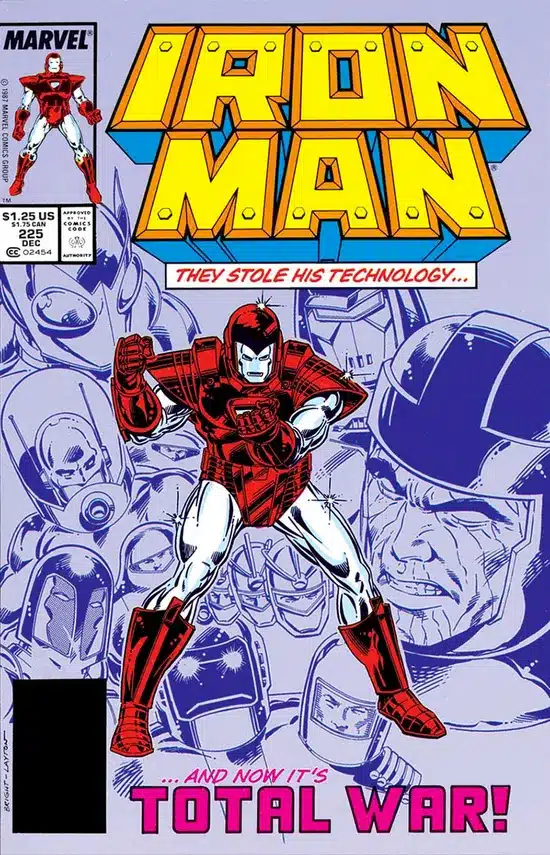
Iron Man #225 Spotlight: The Tech-Noir Classic That Launched the Armor Wars
Iron Man #225 sends Tony Stark into one of the defining conflicts of his career as stolen Stark technology forces him to hunt down armored heroes and villains across the Marvel Universe.
What happens when Tony Stark discovers that some of his greatest inventions — technology he created to protect people — have been stolen, duplicated, and placed in the hands of dangerous armored operatives?
He declares war on his own technology.
Published in December 1987, Iron Man #225 officially launches the storyline that would become known as Armor Wars, one of the most memorable Iron Man stories of the Copper Age.
Writer David Michelinie, co-plotter and inker Bob Layton, and penciler Mark Bright transformed what could have been another armored-supervillain battle into something much more personal.
Tony Stark isn’t simply trying to stop criminals.
He is trying to erase his own mistakes.
And the deeper he goes, the more willing he becomes to cross lines that Iron Man normally would not.
For collectors, the result is an affordable Copper Age issue with genuine historical importance. For readers, it remains an excellent example of Iron Man functioning as a paranoid technological thriller rather than a straightforward superhero book.
You can find additional publication information for Iron Man #225, while Comic Book Addicts readers can explore more stories from the character throughout our Iron Man archives.
The Armor Wars Begin
The central idea behind Armor Wars is frighteningly simple.
Tony Stark realizes that his proprietary armor technology has escaped his control.
After examining technology connected to other armored characters, Stark determines that designs derived from his work have spread far beyond Stark Enterprises.
His inventions are now being used inside armor belonging to criminals, government personnel, and other technologically enhanced combatants.
For Tony, that changes everything.
He has always understood that creating powerful technology carries responsibility.
But Armor Wars takes that responsibility to an extreme.
Tony does not simply decide to report the stolen technology.
He decides to personally eliminate it.
Every suit.
Every weapon.
Every unauthorized application of Stark designs.
Whether the person wearing it considers themselves a hero or villain becomes increasingly irrelevant.
The original storyline was promoted under the Stark Wars name, but the conflict eventually became permanently associated with the title Armor Wars.
And Iron Man #225 is where Tony’s crusade truly begins.
Tony Stark Turns Against His Own Legacy
The most compelling part of the storyline is that Tony’s enemy is ultimately his own legacy.
He built the technology.
Someone stole it.
Other people weaponized it.
But Tony sees himself as responsible for every consequence.
That guilt becomes obsession.
Rather than trusting institutions to deal with the problem, Tony begins developing his own solution, including technology designed to disable armor systems incorporating stolen Stark designs.
The concept sounds reasonable at first.
Then the target list grows.
Characters such as Stilt-Man, the Controller, the Raiders, Crimson Dynamo, Titanium Man, and the Guardsmen become pieces of a much larger technological purge.
Tony’s perspective is increasingly uncompromising:
If Stark technology is inside the armor, he is taking it back.
That mindset is what gives the story its tension.
The question quickly stops being whether Tony can neutralize the armor.
The question becomes:
Who gave Tony Stark the right to decide?
The Ghost Helped Set the Stage
The technological paranoia surrounding Armor Wars did not appear from nowhere.
Earlier issues of Iron Man had already begun exploring corporate espionage, sabotage, and the growing danger surrounding Stark technology.
One important piece of that era is the introduction of the mysterious industrial saboteur known as Ghost.
Readers interested in that part of the run can revisit Comic Book Addicts’ feature on Iron Man #219 and the debut of Ghost.
By the time Iron Man #225 arrives, Tony is increasingly confronting the reality that technological superiority creates vulnerabilities along with advantages.
Every breakthrough can be stolen.
Every invention can be reverse-engineered.
And every weapon can eventually be turned against its creator.
Armor Wars takes that fear and pushes it to its logical extreme.
Why Armor Wars Still Works
Technology has changed dramatically since 1987.
The central question behind Armor Wars has not.
Who is responsible when powerful technology escapes the control of its creator?
That issue feels even more relevant now than it did when the story originally appeared.
Tony cannot simply claim that someone stole his inventions and therefore none of the consequences are his responsibility.
He knows what his technology can do.
He understands how dangerous it can become.
So he chooses direct action.
The problem is that Tony’s solution creates an entirely different ethical crisis.
To stop unauthorized use of Stark technology, he increasingly behaves as though his ownership of the technology gives him authority over everyone using it.
The result is classic morally gray Iron Man storytelling.
Tony may have the right objective.
His methods become increasingly difficult to defend.
Iron Man Versus the System
Armor Wars becomes especially interesting once Tony’s campaign moves beyond obvious supervillains.
Neutralizing criminal armor is one thing.
Going after technology used by government-backed operatives is something else.
As the Armor Wars storyline expands, Tony’s actions put him into conflict with institutions and allies who do not share his belief that recovering stolen Stark technology justifies virtually any action.
That escalation pushes Iron Man away from the comfortable structure of superhero versus villain.
Tony increasingly becomes the disruptive force.
He is willing to challenge governments.
He is willing to break rules.
He is willing to damage relationships.
And eventually, even his position among other heroes becomes strained.
The storyline’s impact extends beyond the pages of Iron Man, with its consequences intersecting with the larger Avengers chronology.

The Silver Centurion Armor Defines the Era
Another major reason collectors and readers remember Iron Man #225 is the Silver Centurion armor.
The red-and-silver design remains one of Tony Stark’s most distinctive looks.
Unlike many later Iron Man armors built around increasingly sleek technological concepts, the Silver Centurion suit has a strong visual identity immediately associated with this period of the character.
It looks powerful.
Mechanical.
Experimental.
And slightly dangerous.
That makes it a perfect suit for Armor Wars.
Tony is not operating as the polished corporate superhero of later eras.
He is engaged in a relentless campaign against technology derived from his own work.
The Silver Centurion armor visually reinforces that harder-edged version of Iron Man.
David Michelinie, Bob Layton and Mark Bright Deliver a Defining Iron Man Story
The creative team deserves much of the credit for why Armor Wars has remained important.
David Michelinie and Bob Layton understood that Iron Man stories work particularly well when Tony’s greatest problems come from technology, business, responsibility, and his own decisions.
Tony Stark can defeat another armored villain.
That alone is not especially interesting.
What happens after Tony wins is usually more important.
Does his technology create another threat?
Did Stark Industries make something dangerous?
Did Tony’s confidence prevent him from seeing the consequences?
Armor Wars builds an entire storyline around those questions.
Mark Bright’s artwork provides the necessary mechanical energy, giving armored confrontations a sense of physical weight while still allowing the character drama to drive the story.
The result is a storyline that feels unmistakably late-1980s Marvel while remaining highly readable today.
A Seven-Issue Copper Age Iron Man Event
The primary Armor Wars storyline runs through Iron Man #225–231, creating a manageable collecting goal compared with many modern crossover events.
Readers interested in exploring the entire sequence can find additional background on the classic seven-issue storyline.
Marvel has also continued returning to the storyline through collections, retrospectives, and later reinterpretations.
The company’s Armor Wars reading guide provides another path through the material, while Marvel has revisited the significance of the story in its overview of what the Armor Wars event means to Iron Man.
The concept proved durable enough that Marvel later explored alternate possibilities surrounding Tony’s campaign, including the question of what might happen if Iron Man actually lost the Armor Wars.
Collector Spotlight: Why Iron Man #225 Matters
From a collecting perspective, Iron Man #225 occupies an appealing part of the market.
It is important without typically carrying the price tag associated with major Silver Age or Bronze Age Iron Man keys.
Its collector appeal includes:
- Beginning of the original Armor Wars storyline
- Major David Michelinie and Bob Layton Iron Man story
- Mark Bright artwork
- Silver Centurion-era Iron Man
- Copper Age Marvel significance
- Beginning of a storyline repeatedly revisited by Marvel
- Strong connection to Tony Stark’s technological legacy
- Affordable raw copies compared with many major Marvel keys
That combination makes it a particularly attractive issue for collectors building an Iron Man run without spending hundreds or thousands of dollars on every key.
Raw, Graded or Signed?
For most collectors, a clean raw copy is perfectly reasonable.
The book remains accessible enough that searching for a sharp copy with strong corners, clean spine, and good registration can be part of the fun.
Higher-grade copies also make attractive grading candidates, particularly for collectors assembling slabbed Copper Age keys.
Creator signatures can add another dimension.
Because David Michelinie, Bob Layton, and Mark Bright are directly associated with the storyline, signatures from members of the creative team have a strong connection to the book rather than feeling randomly added.
For anyone pursuing signatures, condition still matters.
On books from this era, the greatest premium generally comes from combining an important issue, a relevant creator signature, and a high numerical grade.
Why Iron Man #225 Belongs in an Iron Man Collection
There are more expensive Iron Man comics.
There are rarer Iron Man comics.
There are certainly older Iron Man comics.
But Iron Man #225 represents something collectors sometimes overlook:
an affordable issue where an important story actually begins.
It isn’t valuable merely because somebody appears in one panel.
Its significance comes from the story.
Armor Wars takes Tony Stark’s greatest strength — his technological genius — and transforms it into the source of his greatest problem.
That idea has remained central to Iron Man ever since.
Book Details
Title: Iron Man #225
Publisher: Marvel Comics
Release: December 1987
Writer: David Michelinie
Co-Plotter/Inker: Bob Layton
Penciler: Mark Bright
Storyline: Armor Wars / Stark Wars
Era: Copper Age
Primary Significance: Beginning of the original Armor Wars storyline
Final Thoughts
Iron Man #225 is one of those Copper Age comics that deserves attention because the story behind the cover matters.
Armor Wars forces Tony Stark to confront one of the most difficult consequences of being a technological genius:
You can create something with good intentions.
You cannot guarantee how other people will use it.
Tony’s response transforms him from inventor into hunter as he begins systematically destroying every unauthorized application of his technology he can find.
That mission eventually costs him far more than damaged armor.
It challenges his friendships, reputation, principles, and belief that being Iron Man automatically puts him on the right side.
More than three decades later, that central conflict remains one of the reasons Armor Wars still works.
For Iron Man readers and Copper Age collectors, Iron Man #225 remains an affordable cornerstone of Tony Stark’s history.
Join the Discussion
Do you have Iron Man #225 in your collection?
What is your favorite issue from the original Armor Wars storyline?
And where does the Silver Centurion armor rank among Tony Stark’s greatest suits?
Follow Comic Book Addicts for more Marvel Comics history, Copper Age collecting, Iron Man coverage, comic reviews, and key-issue spotlights.
Website: https://comicbookaddicts.com/
Iron Man: https://comicbookaddicts.com/tag/iron-man/
Instagram: https://www.instagram.com/comicbookaddicts/
Facebook: https://www.facebook.com/TheComicBookAddicts/
Tumblr: https://www.tumblr.com/blog/thecomicbookaddicts
Pinterest: https://www.pinterest.com/comicbookaddt
X/Twitter: https://x.com/comicbookaddt