

Beyond the Console: The 1982 Debut of DC’s Atari Force
Atari Force officially blasted off into the vibrant landscape of the DC Multiverse on this day, March 31, 1982. Making its first appearance in a series of innovative pack-in issues, the property represented a pensive and industry-shaking collaboration between DC Comics and Atari, Inc. At a time when home gaming was reaching its first “Golden Age,” this multi-dimensional team provided a definitive portal into the high-stakes world of science fiction that went far beyond the simple pixels of the VCS 2600.
The creative powerhouse and authority behind this classic debut includes:
- The Writers: Gerry Conway (The Punisher) & Roy Thomas (Conan the Barbarian)
- The Artists: Ross Andru, Gil Kane, Dick Giordano, and Jose Luis Garcia-Lopez
- Publisher: DC Comics / Atari, Inc.
- The Games: Defender, Berzerk, Star Raiders, Phoenix, and Galaxian
The history of Atari Force is rooted in a narrative of survival. Set in the near future, the story found Earth facing absolute ecological devastation. To save the human race, the Advanced Technology And Research Institute (A.T.A.R.I.) handpicked a diverse, international team of specialists to crew the multi-dimensional starship Scanner One. Their mission was as pensive as it was urgent: find a new planet for humanity to inhabit. Consequently, the transition from arcade-style action to a pensive biography of loss and hope remains a highlight for anyone tracking new comics history.
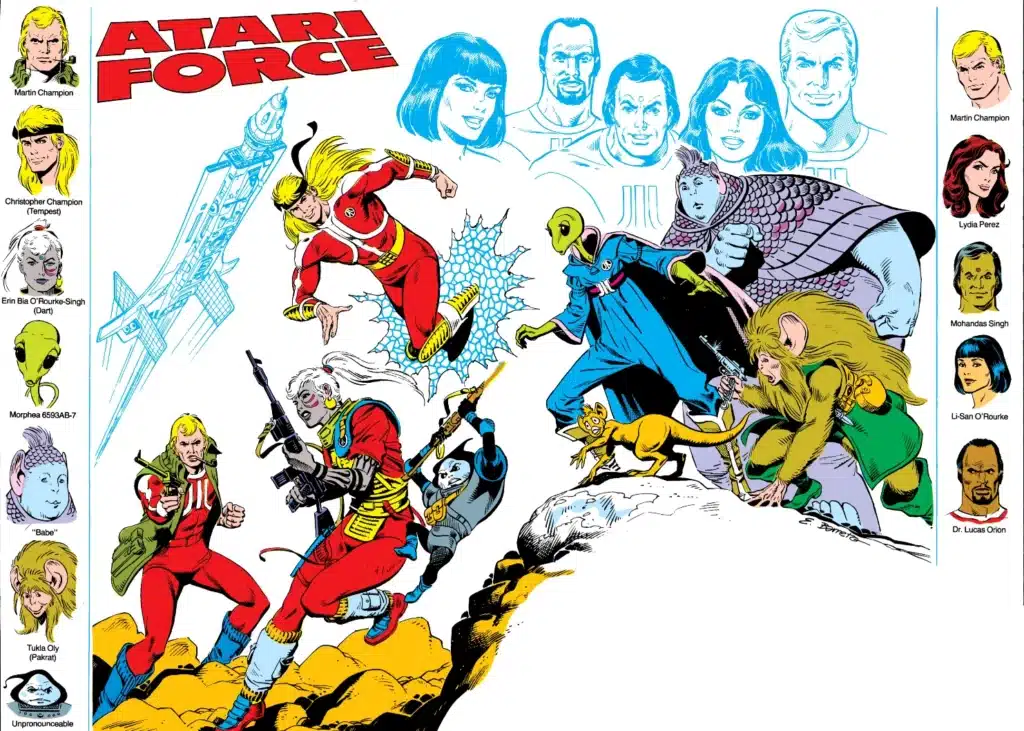
The Crew of the Scanner One in Atari Force
What readers should understand about the March 31st anniversary is the specific hierarchy of the original team. Led by mission commander Martin Champion, the crew consisted of pilot Lydia Perez, security officer Li-San O’Rourke, flight engineer Mohandas Singh, and medical officer Dr. Lucas Orion. This “multi-ethnic” approach was a pensive revelation for the early 80s, establishing a level of world-building intelligence that paved the way for later hits like Star Trek: The Next Generation.
The pacing of their early adventures was fast and visceral, mirroring the high-energy gameplay of the cartridges they accompanied. Along the way, the team was joined by a semi-sentient alien mascot named Hukka—a creature whose name was derived from the distinctive noise it made. Transitioning from the quiet character studies of the archives to the sudden, explosive confrontation with cosmic threats, the script maintains a hierarchy of suspense that is “completely off the charts.”
From Pack-In Comics to DC Continuity
Visually, the comic book covers and interior art by legends like Ross Andru and Gil Kane in Atari Force #1 created an immediate sense of prestige. While the initial run only lasted five mini-comics, the success of the characters was an extraordinary mathematical certainty. This led to a full-sized monthly series in 1984, illustrated by the unparalleled Jose Luis Garcia-Lopez. This later era “unwrapped” the consequences of the original mission, focusing on the next generation of the Champion family.
Furthermore, the volume utilize the unique strengths of the multiverse to explore how diverse cultures and species can unite for a common goal. The interaction between the human crew and the vibrant environments of the worlds they discovered remains a highlight of the era. Whether you are following the tactical movements of the Scanner One or simply soaking in the spectacular 80s artwork, this series is a mandatory addition to your collection. It is a mathematical certainty that fans of retro gaming and classic DC storytelling will find this to be a standout “New Comic Book Day” revisit.
In conclusion, Atari Force is an essential, if often overlooked, pillar of the 1980s comic landscape. From its debut as a pensive promotional item to its status as a seasoned space opera, it reflects the power of original voice and world-class sequential art. Whether the crew is haunting the mind of a digital villain or leading a charge for a new home, their legacy is one of courage and absolute narrative authority. Don’t miss this portal into the “Joysticks and Justice” era when you revisit the classics this month!
📢 Join the Conversation
Who is your favorite member of the original Scanner One crew—Martin Champion or the lovable Hukka? Do you remember getting these mini-comics with your Atari 2600 games? Join the conversation on X and tag us @comicbookaddt to share your favorite Atari Force memories!
Follow our community for more updates:


