Chrome, Pouches, and Polybags: Why 90s Comic Book Collecting Was the Ultimate Fan Experience
90s Comic Book Collecting is officially remembered as the pensive and spectacular “Age of Excess,” offering a volatile portal into a world where every single issue felt like a million-dollar lottery ticket. If you walked into a comic shop in 1992, you weren’t just buying stories; you were participating in a vibrant cultural phenomenon that blended high-stakes investment with some of the most bombastic art the medium had ever seen. For fans who want to understand the foundations of the modern “collector” mindset, this decade is the definitive blueprint for everything we love (and sometimes fear) about the hobby today.
The creative powerhouse and authority behind this industry-shaking era includes:
- The Architects: Jim Lee, Todd McFarlane, Rob Liefeld, Erik Larsen, Jim Valentino, Marc Silvestri, and Whilce Portacio.
- The Major Players: Marvel Comics, DC Comics, and the unwrapped powerhouse of Image Comics.
- The Mastermind: Jim Shooter (Editor-in-Chief during the pivotal transition years).
For anyone tracking new comics history, the 1990s represented a period where the rule-breaking rhythms of the “Extreme” aesthetic dominated the stands. It was a time of bullets and mullets, where heroes had more pouches than personalities, and every #1 issue came sealed in a black polybag. But despite the questionable choices of the era, the sheer joy of the hunt made it a mathematical certainty for fun.
The Image Revolution: Seven Artists Against the Machine
What readers should understand about 90s Comic Book Collecting is that the status quo was shattered in early 1992 when the top artists at Marvel decided to walk away and form their own company. This dynamic shift gave us Spawn, Savage Dragon, and WildC.A.T.S., proving that creators could be as important as the characters they drew. The intelligence behind this move forced the Big Two to innovate, leading to an explosion of spectacular events designed to keep fans rekindled and engaged.
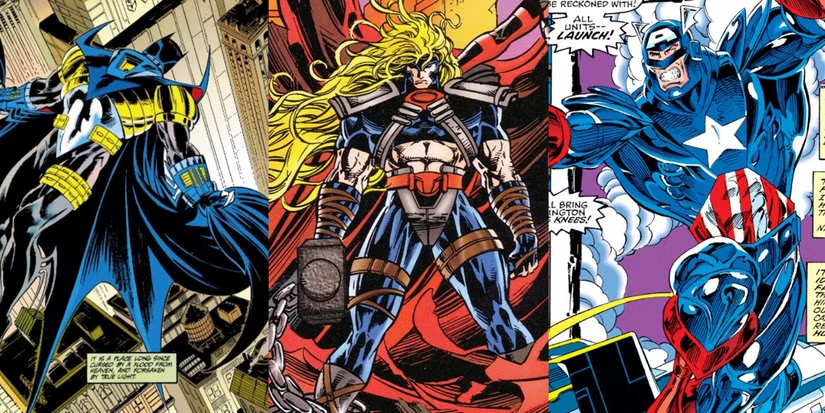
The Image Revolution didn’t just change who owned the characters; it changed how the characters looked. Anatomical reality was traded for stylized power, and the “splash page” became the primary unit of currency. For a kid in the 90s, seeing Todd McFarlane’s intricate “spaghetti webbing” or Jim Lee’s tactical armor designs was a revelation. It made the medium feel “dangerous” and fresh in a way that the more conservative Bronze Age simply couldn’t match.
The Speculator Boom: Investing in Cardboard and Ink
The pacing of the decade was relentless, fueled by the pensive belief that modern comics were as stable as gold bars. We witnessed the Death of Superman, which became a pensive mainstream news event, and the breaking of the Bat in Knightfall. Transitioning from the pensive narratives of the Silver Age to these high-intensity spectacles ensured that the energy remains at a critical mass for anyone revisiting the archives today.
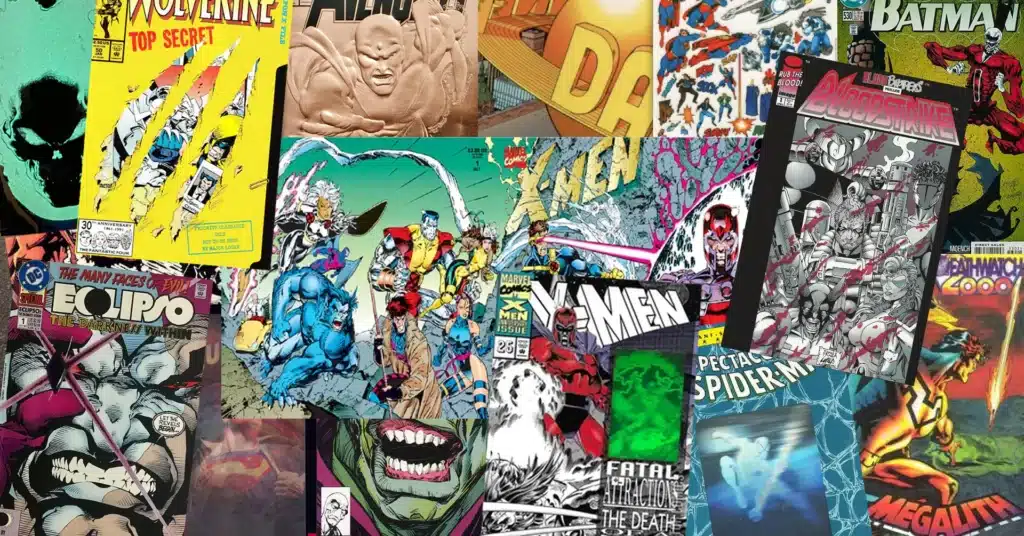
The “polybagged” phenomenon reached its peak with X-Men #1 (1991), which sold an unprecedented 8.1 million copies across five different variant covers. At the time, collectors were buying entire cases of these books, convinced that they were securing their retirement. While the implosion of the market in 1996 proved most of these “investments” worthless, the excitement of the hunt was undeniable. Every Wednesday felt like a treasure map leading to the next “key” issue.
The Gimmick Era: Foil, Holograms, and Die-Cuts
Visually, 90s Comic Book Collecting was defined by a technological arms race. If an issue didn’t have a hologram, a glow-in-the-dark acetate cover, or a die-cut shroud, did it even exist? While these manipulating marketing tactics eventually led to the 1996 crash, the initial momentum was purely magical.
Some of the most awesome gimmicks included:
- The Ghost Rider #15 Glow-in-the-Dark Cover: A definitive pensive artifact of the era.
- The Silver Surfer #50 Chrome Cover: The first to utilize the “foil-stamping” process.
- The Web of Spider-Man #100 Hologram: A 3D innovation that made every shelf pop.
Furthermore, the volume of new comics hitting the shelves meant that niche sci-fi and horror titles could actually flourish alongside the superheroes. From the grim reality of The Punisher to the experimental storytelling of Vertigo, the industry was more sophisticated than the “pouches” reputation suggests. The interaction between the extraordinary characters and the over-the-top art provided a rhythmic tension that carried the reader through the decade.
The 1996 Crash: Why the Bubble Burst
By 1996, the industry faced a catastrophic reality check. The speculator bubble finally burst as collectors realized that millions of copies of “limited” editions weren’t actually rare. Marvel Comics filed for Chapter 11 bankruptcy, and thousands of comic shops across America were forced to close their doors. This failure was a pensive cautionary tale that almost ruined the medium forever.
However, the things we don’t miss about the era—the ridiculous crossovers and the unpredictable delay cycles—were eventually replaced by a focus on narrative stability. The industry survived because the fans’ nostalgia for the characters outweighed the frustration of the market. It is a mathematical certainty that the survival of the medium in 1996 paved the way for the cinematic dominance we see today.
In conclusion, 90s Comic Book Collecting was a wild, unwrapped, and often ridiculous ride that forever changed the hierarchy of pop culture. By pairing the world-building expertise of veteran architects with the raw energy of the Image revolution, the industry avoided a total implosion and emerged stronger. Don’t miss this portal into the “Chrome and Glimmer” era when you revisit your collection this month—just remember that those black polybags were meant to be opened!
📢 Join the Conversation
What was your favorite 90s gimmick cover—the Ghost Rider glow-in-the-dark or the Silver Surfer chrome? Did you buy ten copies of X-Men #1 thinking they’d be worth millions? Join the conversation on X and tag us @comicbookaddt to share your most extraordinary 90s memories!
Follow our community for more updates: