The Looter: This Day In Comics – Amazing Spider-Man #36
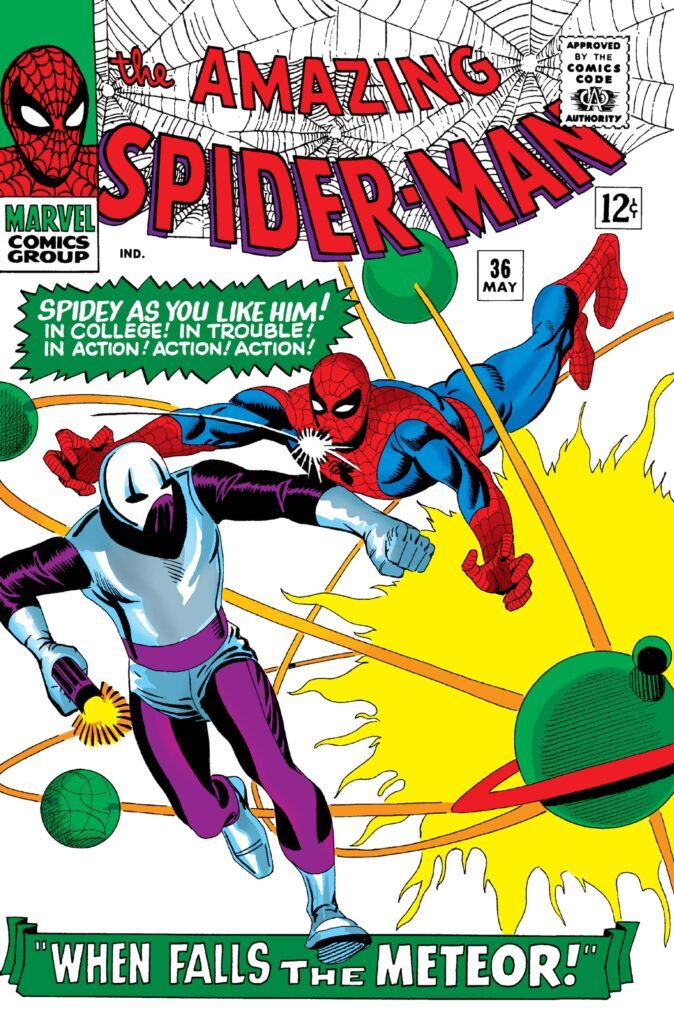
The Looter first appeared in the pages of The Amazing Spider-Man #36 on February 10, 1966. In the pantheon of Spider-Man’s eccentric rogues’ gallery, few characters capture the strange, experimental energy of the Silver Age quite like Norton G. Fester. Long before he donned a mask and started raiding financial institutions, Fester was a struggling scientist whose ambition far outweighed his resources or his social standing in the community.
The creative team behind this iconic first appearance includes:
- Writer: Stan Lee
- Artist: Steve Ditko
- Publisher: Marvel Comics
Fester was consistently viewed as a crackpot by his professional colleagues, which fueled a deep-seated resentment toward the established scientific community. However, his life took a drastic turn when a mysterious meteor crashed into the Earth. Believing this was his ticket to fame and fortune, Fester sought funding for a specialized research project to study the space rock. Unfortunately, investors were unimpressed with his reputation and chose to put their money into more commercial ventures instead.
The Origin and Powers of The Looter
The transformation into The Looter was the result of Fester’s desperation and lack of safety protocols. Refusing to let his discovery go to waste, he began working on the meteor in a makeshift lab without any external funding. While he was chiseling away at the alien stone, he accidentally punctured a hidden pocket of pressurized gas. Fester was immediately immersed in the strange compound. This immersion granted him incredible superhuman strength and agility, providing him with the physical tools he needed to finally strike back at the world.
Instead of sharing his discovery with mankind, Fester decided to embark on a life of crime. Adopting the name The Looter, he began striking banks and corporate offices with a level of power that local authorities were unprepared to handle. He viewed these thefts as simple “reimbursements” for the years of neglect he had suffered as an ignored genius. Meanwhile, Spider-Man was just beginning to realize that the streets of New York were becoming populated by a new breed of super-powered criminals.
The Infamous Hot-Air Balloon Battle
What truly cemented The Looter in the minds of readers was his first major confrontation with the wall-crawler in Amazing Spider-Man #36. Realizing that his powers might eventually fade without a fresh supply of the meteor gas, Fester attempted to steal another meteor from a local exhibit. This led to a high-flying skirmish that moved from the ground into the sky, eventually culminating in a bizarre battle aboard a hot-air balloon.
Despite his enhanced strength, Fester’s lack of tactical experience was his undoing. Spider-Man managed to defeat him by using his superior agility and web-shooters to ground the villain. Since that day, Fester has attempted to reclaim his former glory multiple times—even changing his name to Meteor Man at one point—but he has had no success whatsoever. His career serves as a cautionary tale of how quickly a surge of power can lead to a lifetime of failure.
Furthermore, his debut remains a fascinating study for those who enjoy comic book covers from the Ditko era. The art emphasizes Fester’s unhinged nature, showcasing the shift from a mild-mannered scientist to a frenzied thief. For fans who track new comics and character histories, the evolution of Fester highlights the “one-hit-wonder” archetype of the 1960s Marvel Universe.
In addition, the character’s longevity is surprising given his repeated losses. He represents a specific type of villain who believes they are a mastermind, even when the results suggest otherwise. Transitioning from a crackpot researcher to a costumed failure was perhaps the only destiny available for a man like Norton G. Fester. The themes of social isolation and unearned power continue to resonate in modern interpretations of these classic characters.
In conclusion, The Looter is a quintessential Silver Age villain whose origins are as strange as his choice of aerial transportation. From his debut as a disgraced scientist to his humiliating defeat in a hot-air balloon, Norton G. Fester remains a mathematical part of Spider-Man’s history. Whether you view him as a threat or a joke, his impact on the early Marvel mythos is undeniable and continues to be discussed by historians of the medium.
What did you think of this issue? Join the conversation on X and tag us @comicbookaddt!